
Oro Valley Lookup Record Paths
A one-person search should start with the record most likely to answer the question. The Pima County Assessor can show a current ownership interest and the address used for tax mail. That is a lead, not proof that someone lives on the parcel. Recorder documents add party roles and a legal description. Court files can distinguish a case from a rumor, while vital indexes document eligible historical events. Business filings and license records can separate people who share a name.
| Official record | Fact it can support | Custodian or search | Access route |
|---|---|---|---|
| Parcel roll | Owner, mailing address, situs and parcel link | Pima County Assessor | Free web search |
| Recorded instrument | Name variants, party role, date and land link | Pima County Recorder portal | Web index and image; office fallback |
| Court index and file | Case number, court, dates and disposition | Arizona Public Access and the court clerk | Free index; copies vary |
| Birth or death record | A qualifying event and identity details | Pima County Vital Records | Restricted current copy; free historical index |
| Entity filing | Business role, agent, principal and filing history | Arizona Corporation Commission | Free entity search |
A resident lookup should not force every name through every system. Start with a known parcel for an address question, a court for a known case, or the historical index for an old birth or death. Add a second source only when it tests identity. The PimaMaps parcel viewer and Treasurer roll can corroborate a property lead, but neither supplies a household list. Non-owner residents, children, and other unlisted household members may never appear.
Confirming Oro Valley Name Matches
Common names are the main trap. A strong Oro Valley resident lookup ties a person to a stable identifier before drawing a conclusion. On property records, that identifier may be a parcel number, subdivision, or legal description. On court records, it may be a case number, court, filing date, and case type. Recorded deeds deserve special care because a trust, estate, company, or association can resemble an individual's name in a short index result.
- Search the Assessor by owner name. Keep only parcels whose situs jurisdiction says Oro Valley, since a postal city label alone does not establish town jurisdiction.
- Read situs and owner mailing address as separate fields. Matching addresses support an owner-occupancy clue, but they do not prove residence.
- Carry the parcel or recording reference to the Recorder. Check the deed image for party capacity, co-grantees, exact vesting, and legal description.
- Search a court or vital index only when it can test a distinct fact. Confirm the match with the office that holds the actual record.
Try spelling variants and names without punctuation. The Recorder expressly compares its index to a library card catalog. The image is the fuller source. Dates also need context: execution, recording, sale, and move dates may differ. A neat match across two short abstracts can still identify the wrong person if neither record shares a sound parcel, case, or event key.
- Docket
- The court's running record of filings, events, and rulings in one case.
- Index versus image
- An index points to a record. The image or clerk file contains the fuller document.
- Certified copy
- A custodian-issued copy authenticated as a true copy of its record.
Note: An assessor mailing address is a useful lead, yet the Assessor does not claim that it proves where an owner sleeps.
Arizona Court Records for Oro Valley
The Arizona Public Access to Court Information system offers Case Search, Minute Entry Search, and Case Notification after a verification screen. It reports participation by 177 of 184 Arizona courts. The index refreshes each Friday with information through the prior Wednesday. It is not the official court record, and sealed cases, protection orders, mental-health matters, probate cases, victim or witness data, and juvenile delinquency matters are among the material it may omit.
Pima County court case records provide the local follow-through for Superior Court files. The source screen below is the assigned resident-lookup image from the official Clerk channel.
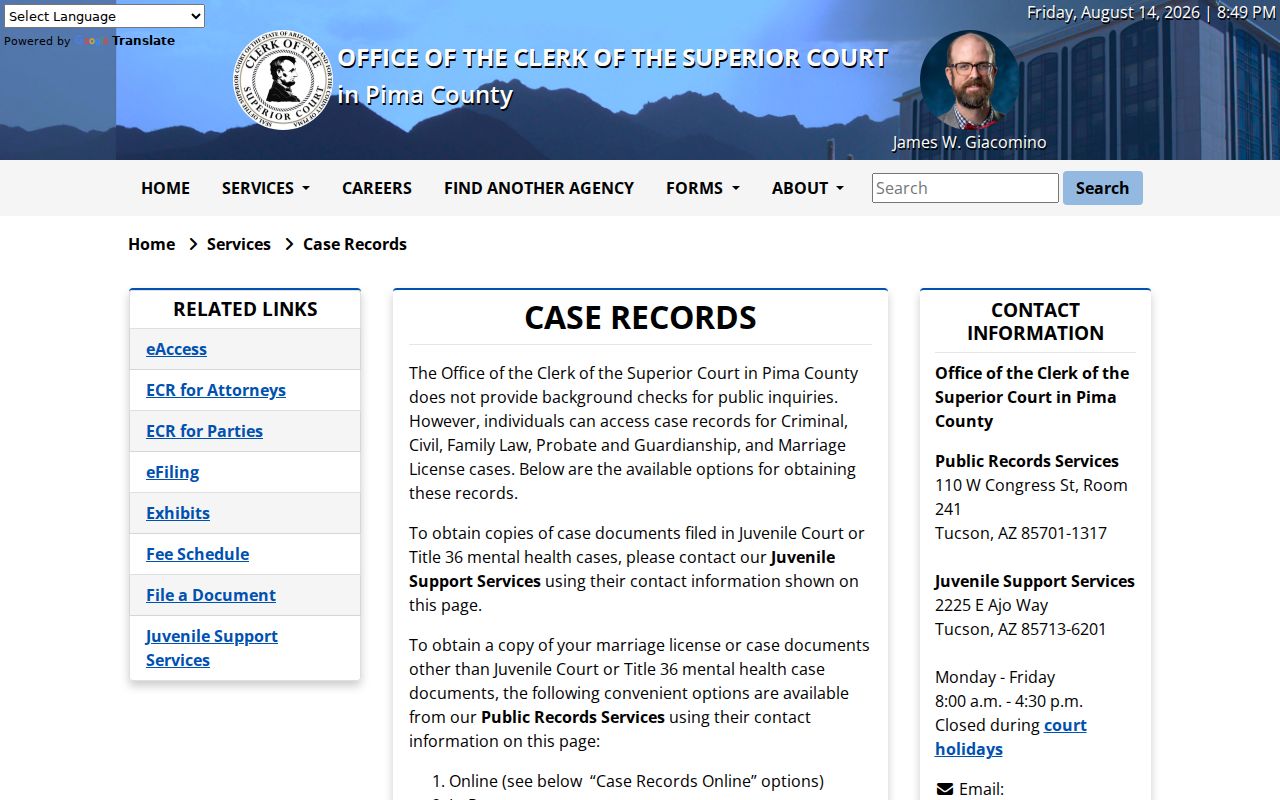
The clerk recommends calling Public Records Services before visiting to learn whether a document can be viewed or bought. Probate can help an heir search even though probate results are excluded from the statewide public index. The absence of an online hit is therefore not proof that no file exists.
Reading Oro Valley Court Results
A court result is a lead to one court's file. It may display the party name, case number, court, case type, filing or event dates, and disposition. A disposition is the recorded outcome or status, not a broad judgment about the person. Name, approximate date, and case location should agree before a match is treated as plausible.
- Party name and spelling shown by the court
- Case number and the court that owns the file
- Case category, filing date, and listed events
- Disposition or current status when displayed
- Document route, if the record is eligible for access
The Arizona eAccess service is a separate document channel. It provides Superior Court civil and criminal documents filed from July 1, 2010, while Pima criminal documents begin July 1, 2015. Sealed or otherwise closed material stays unavailable.
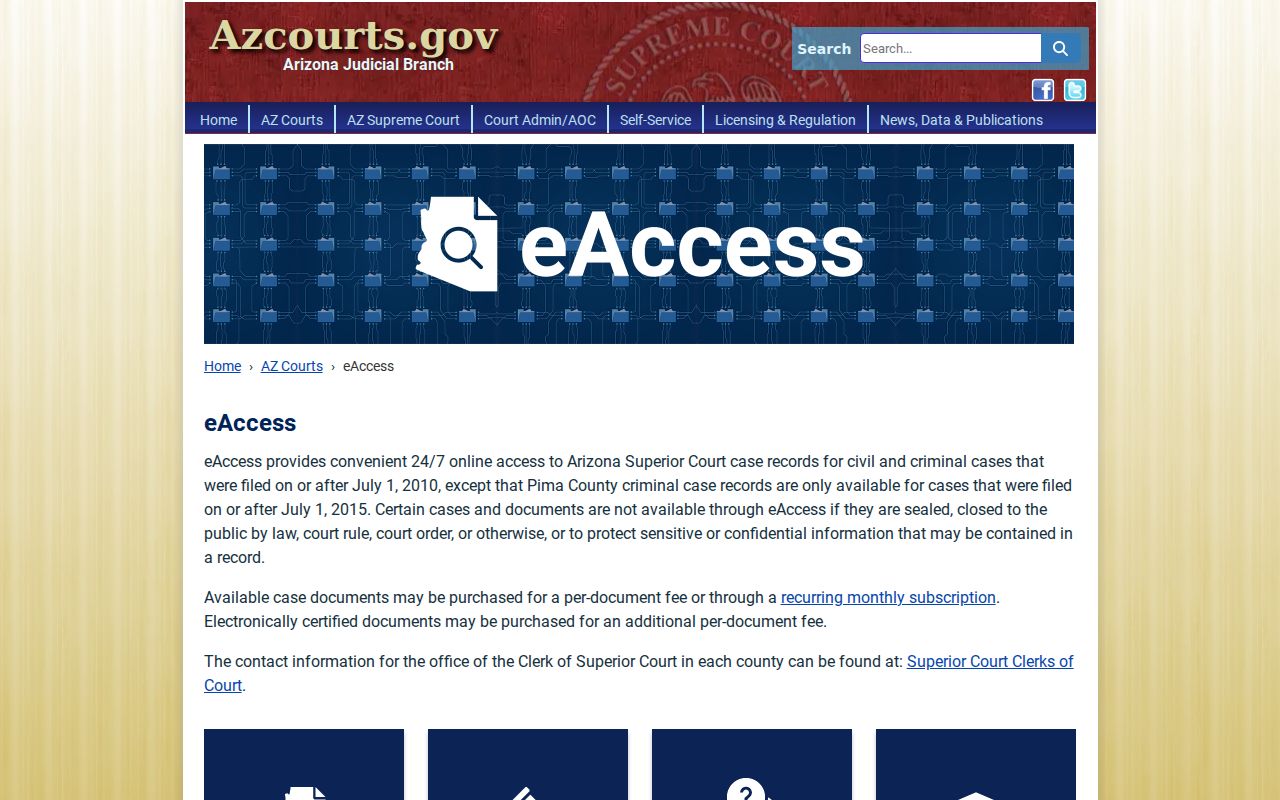
The image shows the official document-access route rather than the statewide index. For an Oro Valley Magistrate Court file, submit the local form by email, fax, mail, or in person at Town Hall. The stated fee is $17 for one case and up to 34 pages, then $0.50 per extra page; most requests are completed within five business days. Federal cases use the judiciary's official PACER route.
Oro Valley Vital Record Doors
Arizona uses different doors for different events. Pima County Vital Records or the state Bureau of Vital Records handles eligible birth and death certificate requests. Marriage licenses and divorce decrees belong with the Pima County Clerk of Superior Court, not the health department. A current birth or death certificate is not an open resident directory record.
For an eligible requester, Pima County offers same-day counter service and mail requests that can take two to four weeks. The $20 processing fee applies to each certified copy. A mailed packet needs the signed form, eligibility proof, identification or notarization, a self-addressed stamped envelope, and payment. The official online vendor may add charges. The public counters are at Abrams Public Health Center and Northwest Service Center.
The age rules create a useful historical path. Arizona Genealogy opens transferred birth records 75 years after birth and death records 50 years after death. That difference is easy to miss. It lets a family-history search begin with a free historical index before any restricted-copy process. The Arizona Daily Star archive adds obituary text from 1991 onward, while the AHS Ayres Index supplies more than 140,000 references and about 300 subject files for much earlier newspaper work.
Oro Valley Heir and Business Trails
When a resident lookup concerns an estate, begin with the decedent's property and the Pima County court clerk. A deed may show an estate or trustee, while a probate file can identify the proceeding and possible heirs. Obituaries and eligible historical death records can test family links. These sources work together because a deed documents title, not every family tie.
For a business role, search the Arizona Corporation Commission by entity name, entity ID, statutory agent, or principal. Results can include legal name, type, status, formation date, known business address, agent, principals, and filing history. A business address does not prove home residence. Use entity numbers and dates to separate same-name people.
The Arizona Unclaimed Property program supplies another lawful name-based trail and an official claim process.
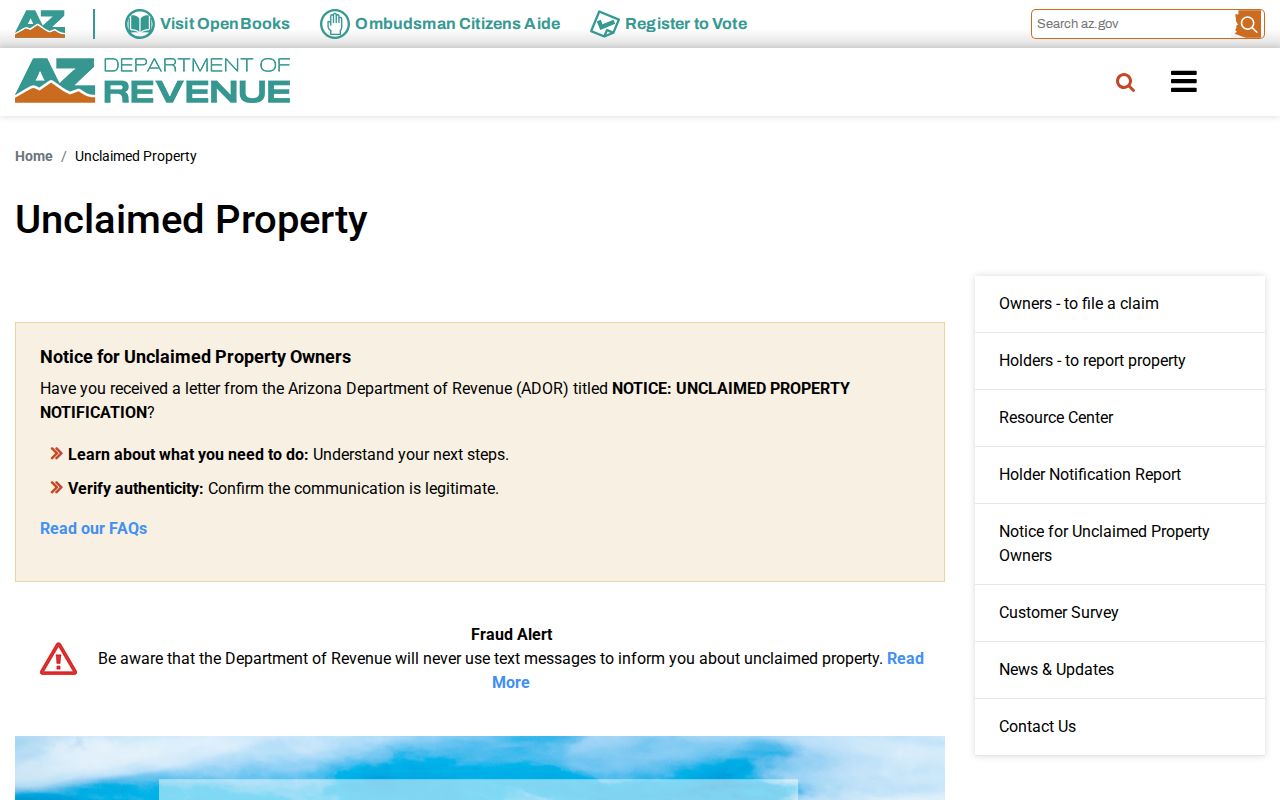
The assigned screen points to the state program, not a paid finder. A match can suggest a former address or name variant, but only the state's claim process determines whether the property belongs to the claimant.
Requesting Missing Oro Valley Records
Online gaps call for the custodian, not guesswork. Arizona Public Records Law, A.R.S. §§ 39-121 through 39-161, opens public-body records to inspection during office hours and requires a prompt response, subject to privacy and confidentiality limits. For a Town record, use the Oro Valley public-request system, choose General, describe the material closely, and give an email for routing and completion notices. Native electronic files are sent electronically when they exist.
Paper inspection is free. If copies carry a charge, the Town sends an invoice before release. A partial denial can be followed by a request under A.R.S. § 39-121.01(D)(2) for an index of withheld categories and the legal reason for each. Court files use their own rules and forms. Older recorded instruments that are not indexed online remain available on Recorder public computers, microfilm, or microfiche, and mail requests can use docket, page, sequence, names, and date.
Arizona DPS criminal-history records follow a narrower path for review. The agency does not provide one private citizen a name-based statewide history about another person. A person can request their own Record Review Packet to review and challenge accuracy.
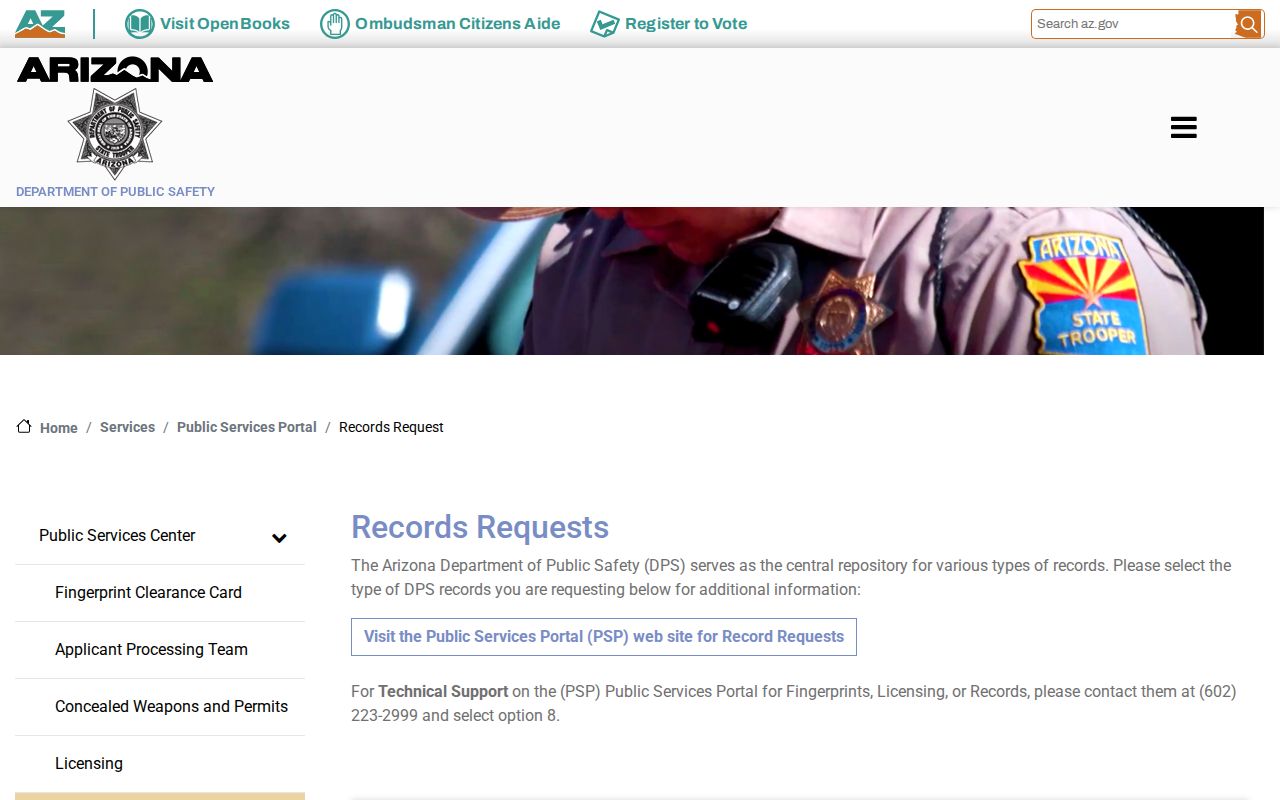
The DPS screen reinforces that the subject's review route and an ordinary public search are different services. The agency states that it mails a response within 15 days after receiving a complete packet.
Correcting Oro Valley Lookup Errors
Corrections belong with the office that created or keeps the source. If a Recorder abstract conflicts with a deed image, keep the document citation and ask the Recorder about its correction process. If a court index appears wrong, contact the court of record and identify the case number. A DPS criminal-history issue uses the subject's Record Review Packet, not a general Town request.
Commercial people-finder entries require a different method. Find the company's own privacy or suppression page, submit only the minimum needed to identify the exact listing, save the confirmation, and check again after processing. Such services can merge same-name people, preserve old addresses, or repopulate from source feeds. They are never a substitute for the official record or custodian.
Note: An omitted or substitute address can reflect a valid safety program, so absence should never be used to infer where someone lives.
Oro Valley Resident Lookup Limits
Some records remain closed by design. The Arizona Address Confidentiality Program gives qualifying protected people a substitute address and mail forwarding. Voter files exclude sensitive identity fields, and the self-service voter portal is for an individual to retrieve their own registration and election information. It is not a browseable list of Oro Valley residents. Recent vital records require eligibility, and court systems omit sealed or protected case types.
A safe resident lookup uses the least data needed, checks identity before contact, and respects a person's choice not to respond. Public access never permits threats, repeated unwanted contact, surveillance, or broad redistribution of a restricted voter file. Arizona harassment and stalking laws apply whether the source began online or at a public counter.
Lawful use. Use an Oro Valley resident lookup only for lawful personal research. Never use a record to stalk, harass, intimidate, or harm anyone.