
Find Oro Valley Residents
A good Oro Valley residents directory search starts with the clue already in hand. A street address points to the Assessor and PimaMaps. A name can travel further, surfacing an owner record, a recorded deed, a court index entry, a business filing, or unclaimed property. An older address calls for deeds. Add subdivision plats, old directories, newspapers, and census schedules. None of these is a household list. Each is a dated record created for a different public task.
Keep identifiers beside every result: the number, the date, the keeper. A parcel number beats a street spelling. A court number separates one case from another. A deed's legal description tells same-name owners apart. Before 1974, the Town of Oro Valley did not exist as a records custodian, so try Tucson, rural Pima County, ranch names, and old subdivisions instead.
- Search the Pima County parcel roll by the known name or address and save the parcel number, situs, jurisdiction, and mailing address.
- Open the parcel in PimaMaps to confirm the municipal line, subdivision, nearby lots, permits, and recorded-document links.
- Inspect the Recorder's actual deed image and follow its grantor, grantee, date, and legal description.
- Use the appropriate court, voter, business, vital, or historical index only for the fact that source can confirm.
- Request the file from its custodian when the web index is incomplete, challenged, or only an abstract.
Oro Valley Records Custodians
Jurisdiction splits Oro Valley records. Town Hall holds council, election, board, contract, permit, license, police, court, and administrative material. Pima County answers for property. The county keeps the current roll, parcel geography, deeds, taxes, and Superior Court files. Arizona agencies handle the rest: statewide court access, vital records, professional credentials, corporations, and protected-address programs. No single office can confirm everyone at one address.
Oro Valley Town Clerk
11000 N. La Cañada Drive
Oro Valley, AZ 85737
520-229-4700
The Town Clerk's official page shows the local request route and Town Hall setting.
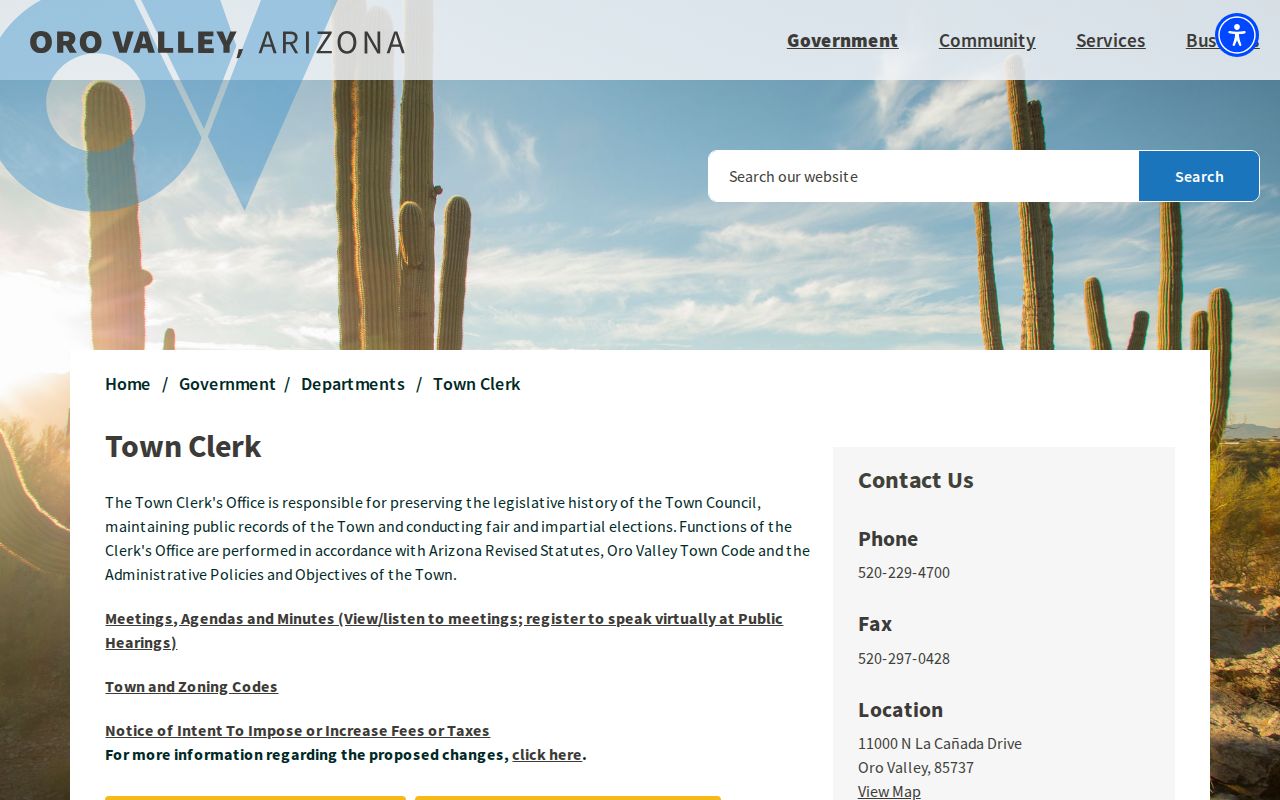
This screen anchors the municipal side of any Oro Valley records search. Use it for material that belongs to no county or state custodian. Offices open weekdays, 8 a.m. to 5 p.m.
Search Oro Valley Parcels
The Pima County Assessor Parcel Search is the fastest official bridge. It links a name to a property. The main box takes a parcel, an address, or an owner name. Other routes work too. Map and plat references can lead there, and so can a recorded-document number. A subdivision name, Public Land Survey System fields, and map browsing all reach the same place. A parcel card can carry plenty. It may list the indexed owner, owner mailing address, situs address, jurisdiction, postal city and ZIP, and legal description. It also covers values, land and improvement facts, images, and recording references.
Situs is the parcel's physical address. The owner mailing address is simply where tax mail goes. A match hints at owner occupancy but proves nothing about who sleeps there. A mismatch has many causes. Use the parcel number and legal description as identifiers. Then confirm title in the deed image itself.
| Assessor route | Best use | Search note |
|---|---|---|
| Parcel, address, or name | Quick first match | Combined autocomplete box |
| Property owner | Find indexed owner parcels | May return a trust, estate, company, or association |
| Property address | Resolve a known situs | Try no punctuation or suffix |
| Subdivision or map | Bridge address changes | Preserves lot and plat geography |
| Recorded document | Link a deed to land | Useful when the street label differs |
The Pima County Assessor search displays the public parcel-search entry point.

Its parcel result is an ownership clue, not an Oro Valley household roster.
Map Oro Valley Record Lines
PimaMaps answers the geographic questions a postal label cannot. Search by owner, address, intersection, or parcel, and skip the punctuation. Pick the result in the left pane, select the parcel, and open More Information; the trail can lead to the Assessor card, subdivision plats, permits, aerial images, zoning, and other layers. Some layers wait for a closer zoom.
This matters at Oro Valley's edges. Postal city, ZIP code, situs, owner mailing address, and municipal jurisdiction are separate fields. Four ZIP codes touch the wider Oro Valley area. Parts carry Tucson labels or unincorporated county land. The municipal boundary layer picks the correct permit and records custodian.
See the PimaMaps parcel viewer before relying on a delivery label.

The map keeps the parcel context intact. It connects a name, deed, permit, and subdivision without mixing up neighboring jurisdictions.
Note: Annexation can shift the responsible public office even when a parcel's ZIP code and physical location stay exactly the same.
Follow Oro Valley Deed Records
Pima County recorded-document history reaches back to 1865. The Recorder's 2021 online-records announcement identifies June 1982 forward as the fully indexed online span. Search party-name spellings first. Flip between grantor and grantee roles, narrow by document type or date, or retrieve a known sequence number and docket/page. An index result gives parties, document type, recording date, docket/page, and sequence number. The image may add vesting, capacity, legal description, notarization, addresses, and other facts.
The portal index works like a library catalog. It points without replacing the instrument itself. Watermarked images and index research are free. Clean digital copies and certified copies cost money. Older unindexed material remains on Recorder public computers, microfilm, or microfiche. When the portal stalls, mail and in-person requests still work, especially with names, dates, sequence numbers, and docket/page citations in hand.
- Index
- A finding aid that points to a record, not the full legal instrument.
- Grantor
- The party transferring an interest in a recorded deed.
- Grantee
- The party receiving that recorded interest.
- Parcel
- A mapped unit of land identified by the county.
- Criss-cross directory
- A directory arranged by street address or telephone number rather than surname.
Current Oro Valley Directory Sources
Current Oro Valley resident clues live in several official systems, each with sharp limits. The property roll lists owners, not occupants. A recorded-document index lists only parties to instruments. Arizona's voter portal serves individuals, not street browsing. Court indexes give case leads but skip protected material and never substitute for the official file. Corporation, license, custody, and unclaimed-property records capture only the people who appear in them.
| Oro Valley source | Fact it can support | Keeper | Access path |
|---|---|---|---|
| Parcel roll | Indexed ownership, situs, tax-mail address | Pima County Assessor | Free web search |
| Recorded documents | Named parties and title chronology | Pima County Recorder | Web index plus office fallback |
| Voter information | A voter's own registration and election data | Arizona and Pima County | Identity-gated self-lookup |
| Court index | Party, case, court, dates, disposition | Arizona courts and local clerks | Index, eAccess, or copy request |
| Town records | Permits, projects, boards, local cases | Town of Oro Valley | Posted records or public request |
| Entity filings | Business role and filed address | Arizona Corporation Commission | Free entity search |
Official records point to a public act and a date. A commercial compilation is looser. Merged names, preserved former addresses, and dropped corrections are all common, so treat an unofficial match only as a clue and go back to the keeper and the underlying record.
| Source type | Best practice |
|---|---|
| Official roll or index | Check its date, scope, identifier, and underlying file with the custodian. |
| Commercial people-search category | Treat a result only as an unverified lead because names and former addresses may be merged or stale. |
Oro Valley Voter Record Limits
The Arizona voter information portal exists so a voter can pull up personal registration details, district assignments, polling places, ballot information, and election dates. It is not an Oro Valley residents directory organized by street. A.R.S. § 16-168 governs what voter lists may contain and how they can be used. Official lists that qualify for release can include a voter's name, party preference, registration date, residence and mailing addresses, ZIP, a telephone number the voter supplied, birth year, and voting history. Voting history here means participation only. Ballot choices are never disclosed.
The statute also blocks sensitive identifiers from these lists and restricts use to political, election, redistricting, or other authorized purposes. Wide Internet reposting and commercial use are prohibited. Protected voters have another option in the Arizona Address Confidentiality Program. Keep in mind that a missing or substitute address proves nothing about whether someone lives in Oro Valley.
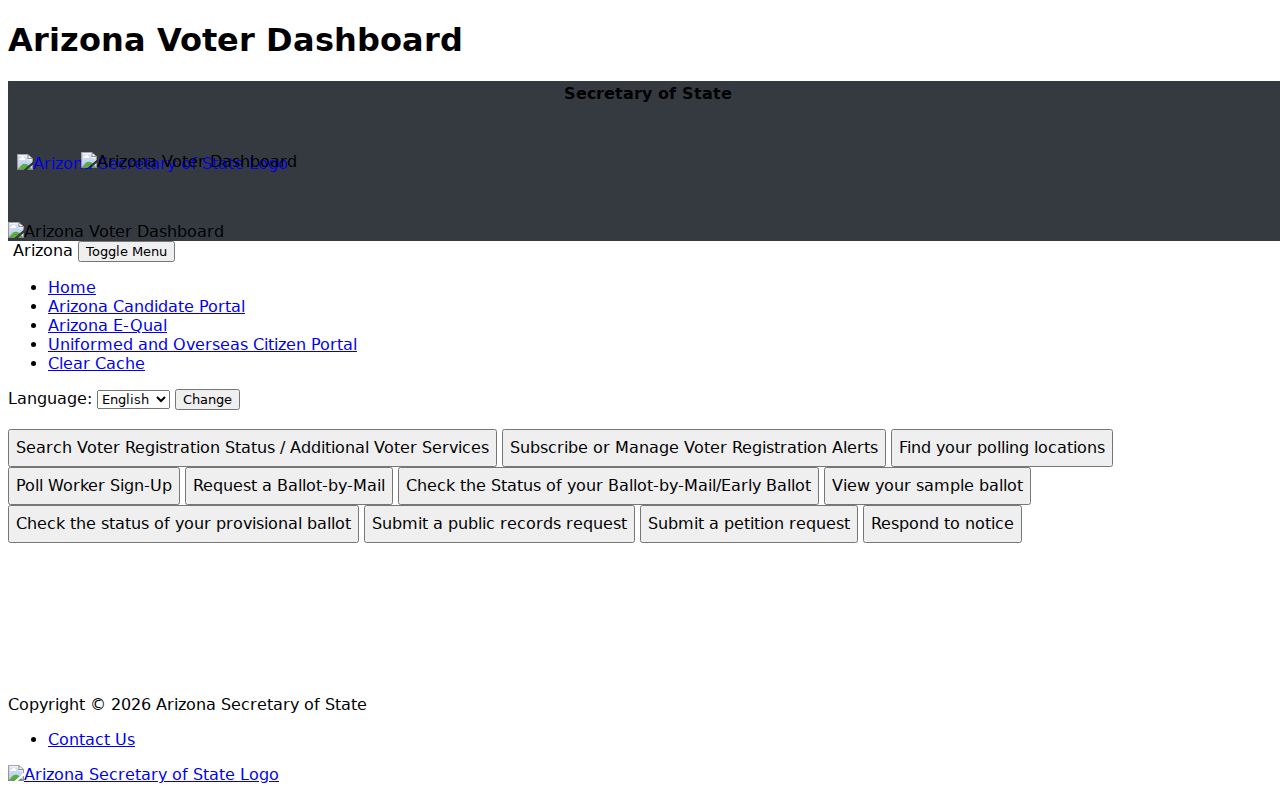
The identity gate separates self-checks from browsing other residents.
Lawful use. Use Oro Valley records only for lawful personal research. Never use an address or identity clue to stalk, harass, threaten, or harm anyone.
Verify Oro Valley Name Matches
A name match is only a lead. Compare middle initials, dates, party roles, case court, parcel number, subdivision, legal description, and the source's update date. Keep an individual apart from a trust, estate, company, or association with a similar label. The Arizona court portal covers most state courts. It refreshes weekly. It also warns plainly that results may be incomplete or stale, and sealed cases plus several protected case types never appear.
Custody searches are live but narrow. The Pima County Sheriff lookup covers current county-jail custody, while the state corrections search covers state prison. Neither is a permanent Oro Valley resident roll. Any result must be checked against its identifier and current status. The Pima County inmate lookup shows that shifting, limited scope.
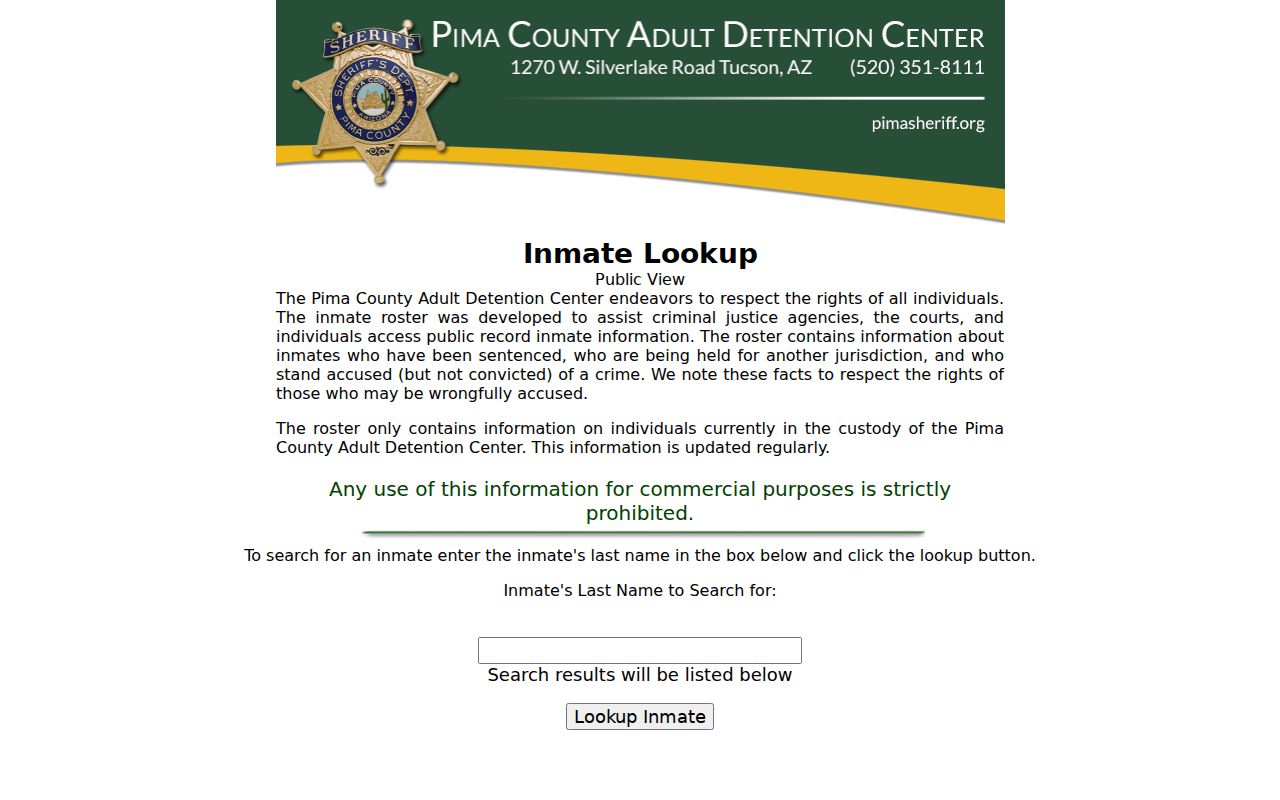
A custody entry confirms only the facts and time shown by the Sheriff's system.
Vital Records Beyond Oro Valley
Birth and death certificates follow a different access rule. Pima County Health Department and the Arizona Department of Health Services issue certified copies. Only eligible applicants with the required proof qualify. Pima County offers counter and mail routes. Its stated certified-copy fee is $20. Mailed applications can take two to four weeks. Marriage licenses and divorce decrees belong elsewhere, in the Pima County Clerk and Superior Court record system.
Arizona Genealogy opens a historical path once the statutory closure period ends. Under A.R.S. § 36-351, birth records open 75 years after birth and death records after 50. Try that free historical index before ordering a restricted current copy when the event is old enough. The Arizona vital-records hub routes applicants to the proper certificate service.

The eligibility rules explain why recent certificates cannot serve as open resident-directory entries.
Oro Valley Business Identity Trails
Start with the state. An Oro Valley name tied to a company belongs with the Arizona Corporation Commission, not a general people finder. Its eCorp search accepts entity name, entity ID, statutory-agent name, and principal name. Results may show the legal entity name, type, status, formation date, known business address, statutory agent, principals, and filing history. Those are organization facts. A business address proves nothing about a home.
Town business licensing adds a local layer through SmartGov and Community and Economic Development. The Town handles general business, home occupation, public market, and several solicitor license types. Retained local material that the account-based portal does not expose falls back to a public-record request. The Arizona eCorp search is the official corporation and LLC route.
Entity numbers and filing dates keep unrelated name-sharers apart.
Historical Oro Valley Resident Directories
Oro Valley has no standalone city-directory run. The practical shelf is the Tucson directory collection. Pair it with rural Pima County records, ranch names, subdivisions, and the Town annexation history. Tucson's first known directory appeared in 1881. Publication became nearly annual after 1899, with exceptions. All editions known to exist through 2003 sit across the Pima County Public Library, Arizona Historical Society, Ancestry, and Arizona Memory Project.
A printed entry fixes a moment. It can tie together a name, spouse, abbreviated role, and address at one point in time. A criss-cross edition flips addresses into occupants. Title, exact move dates, and full households still go unproven. PCPL Infoline will check up to three addresses or telephone numbers in its criss-cross resources, a useful fallback when the volume is not online. The fuller collection and abbreviation workflow belongs in the Oro Valley historical city directory. For an early address, pair its entry with deeds, census records through 1950, newspapers, plats, permits, and aerial images.
Oro Valley Before Resident Records
Resident records only reach so far back. Honey Bee Village changes that timeline completely. It was occupied from roughly A.D. 450 to 1250, with 19 large mounds around a plaza, a ballcourt, and perhaps 500 to 800 domestic houses. Its preserved 13-acre core is the only intact large Hohokam village left in Oro Valley. None of that appears in a residents directory, of course, since the names are long gone. What the archaeology does prove is simple. A town-incorporation date cannot mark the start of settlement in the Cañada del Oro corridor. For named nineteenth-century residents, look instead to ranch records, the 1862 to 1864 property-claims register, early deeds, newspapers, and Tucson-area directories. That deeper timeline reshapes every search question.
Why Oro Valley Geography Shifts
The Town of Oro Valley incorporated in 1974. It had roughly 1,200 residents and a tiny footprint. That date matters for anyone tracing a household. Pima County recorded documents go back to 1865. A Tucson property-claims register covering 1862 to 1864 predates county government itself. So an older family can show up in county deeds and Tucson-area directories. It may never appear in an early Oro Valley file. The starting points simply do not line up.
Neighborhood records carry a trap of their own. A plat only proves land was divided. It says nothing about whether a house stood there or anyone lived in it. Linda Vista Citrus Tracts No. 2 was platted in 1937, but just five of its present houses predate 1965. When searching a residents directory or deed index, treat Campo Bello, Suffolk Hills, Rancho Vistoso, and Steam Pump Ranch as place names. Pusch and Cañada del Oro deserve the same treatment in their own right. If an index or old OCR chokes on the ñ, try the spelling without it.
Note: Oro Valley inspection of paper originals is free. Inspect first, and order only the pages that answer your records question.